

Conventional IVF
Action in the conventional case IVF
(In-vitro fertilization / glass reagent fertilization)
1. Drug-based pre-treatment
With the conventional method IVF, a relatively high number of eggs is produced through pre-treatment with medication. For this purpose, usually 150–225 IU FSH (Gonal-F or Puregon) or a FSH/LH mixture (Menogon) is injected subcutaneously (under the skin) daily. Depending on Stimulation protocol various additional medications will still be needed to prevent premature ovulation (Synarela Spray, Zoladex, Enantone, Dekapeptyl).
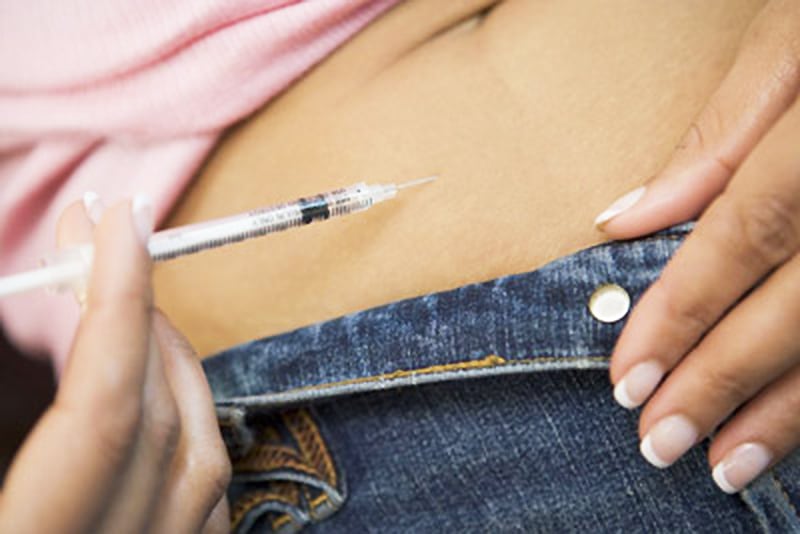
When enough follicles (ovaries) have grown, the so-called „ovulation injection“ (Brevactid, Pregnesin, Ovitrelle) is administered to complete the egg maturation phase. Now the eggs must be extracted.
2nd oocyte retrieval
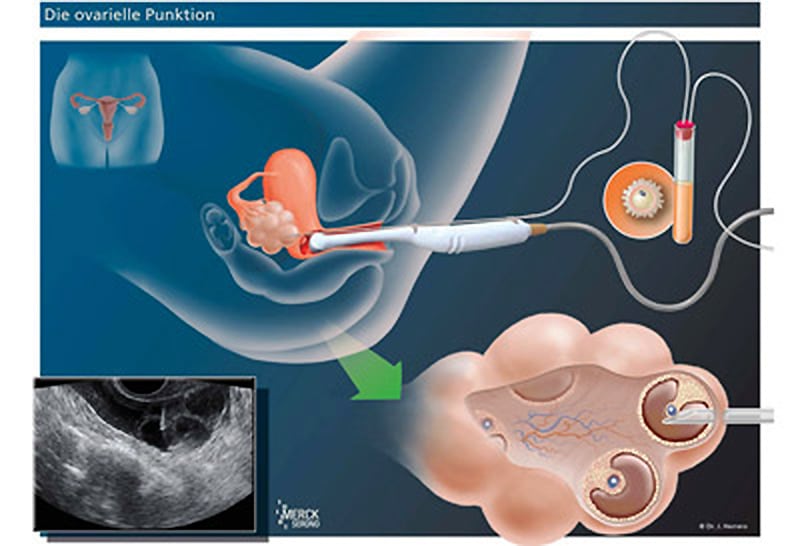
The vaginal follicle puncture under ultrasound control is usually performed under a short general anesthesia 32 to 36 hours after the HCG injection.
A puncture needle is inserted into the vagina through a guide sleeve on the ultrasound head. The ovary is located only a few millimeters away. The needle is then inserted directly into the individual follicles through the vaginal wall. The fluid is aspirated and immediately transferred to the biologist so that it can be immediately determined whether an egg cell is present.
3. Fertilization
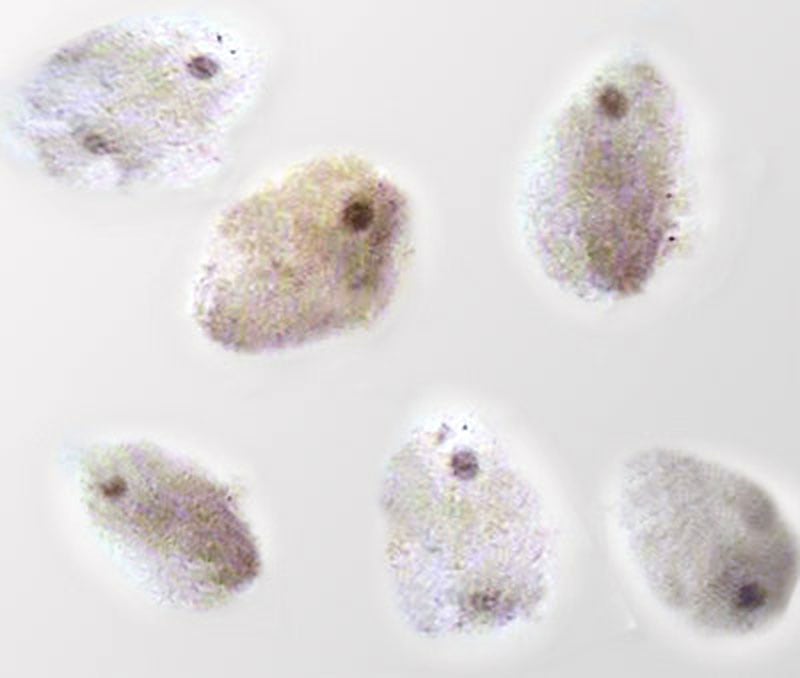
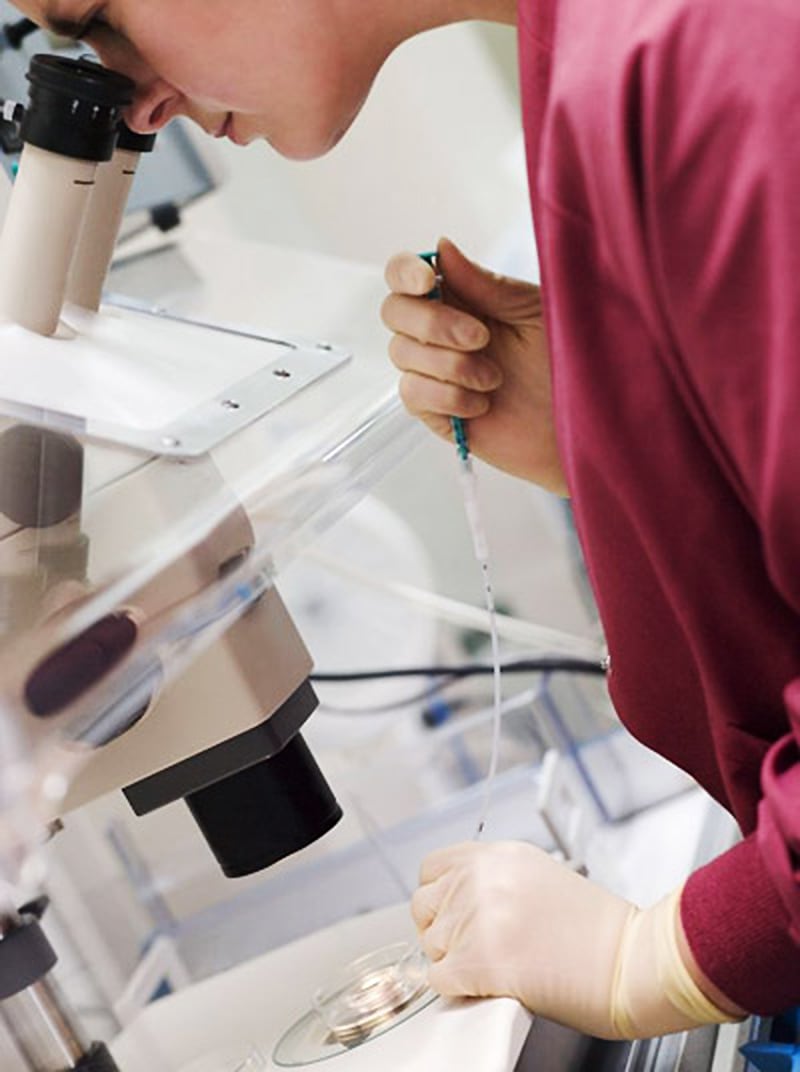
The eggs are placed in a nutrient solution in the laboratory and covered with about 50-100,000 well-moving sperm. The eggs are then „incubated“ (cultured) overnight in the incubator.
After 19-21 hours have passed, it is determined how many eggs have reached the so-called pre-nucleus stage (PN Stadium-Pro Nucleus). It is then necessary to select which PN-stage cells (max. 3) are to complete the fertilization process (at least in Germany). The pre-nuclei each contain the chromosomes of the egg cell and the sperm cell.
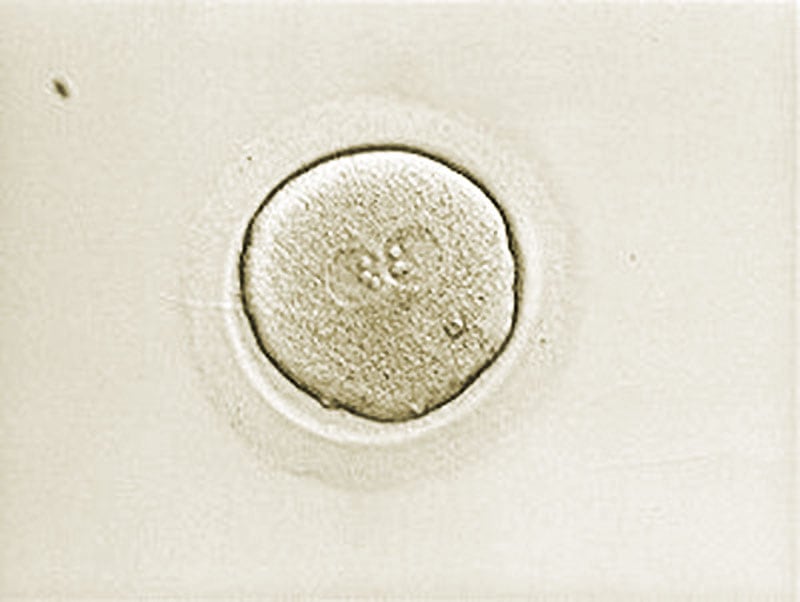
On the 2nd or 3rd day after sperm donation, when one or more embryos have developed, the embryo or embryos are transferred into the uterus. Transfer on the 5th day is also possible and advisable if one or more embryos are present. Blastocyst have emerged.
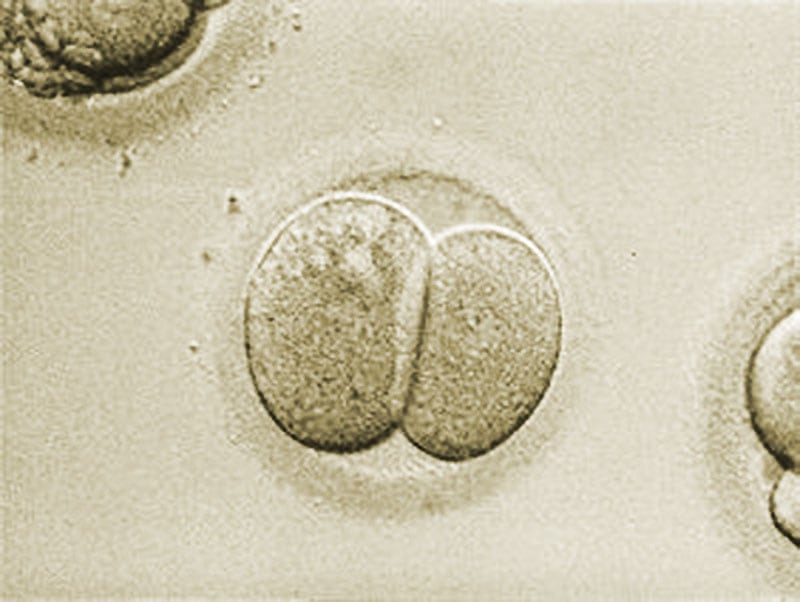
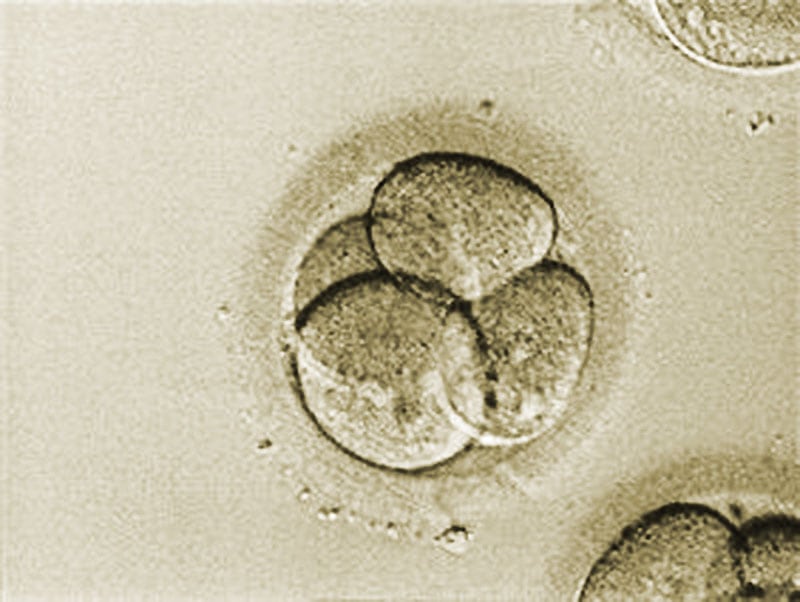
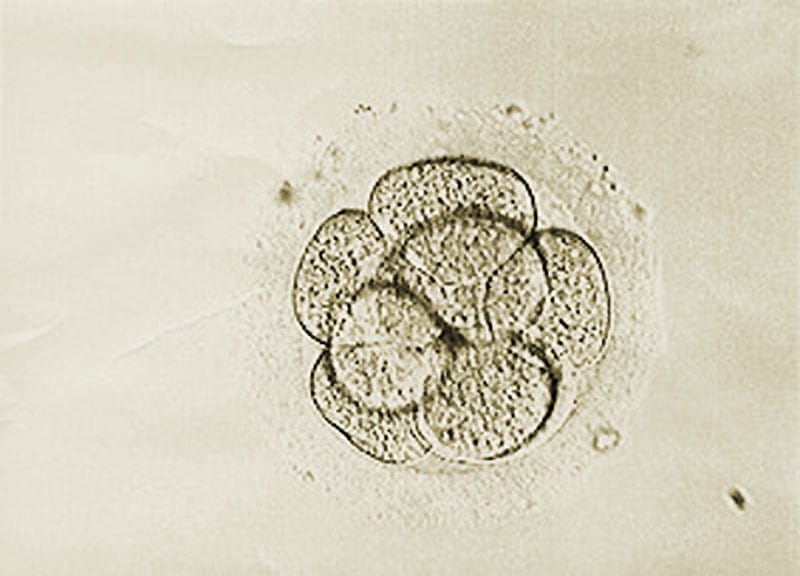
Further information about Blastocyst transfer
4th embryo transfer
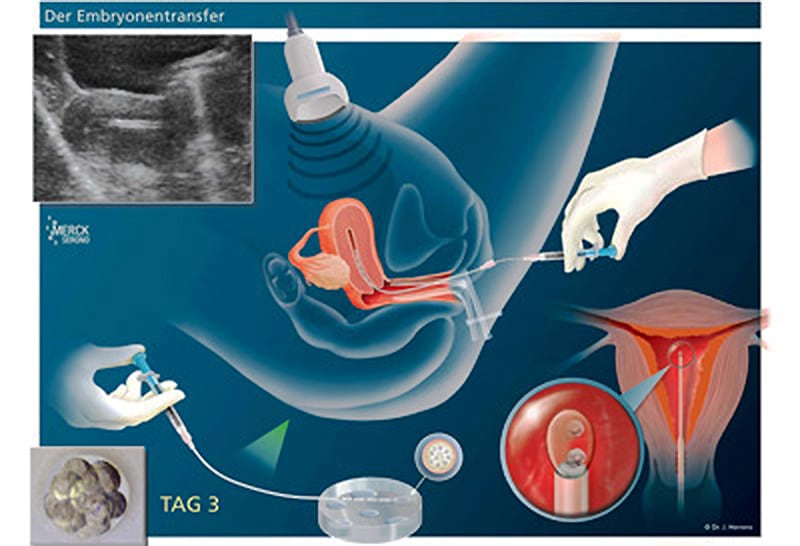
On the 2nd, 3rd or 5th day after the sperm donation, the embryo transfer is performed. In this procedure, a catheter is inserted into the uterus completely painlessly, if necessary under ultrasound control. The embryo or embryos are carefully deposited there.
To prepare for this transfer, the woman may take medications that relax the uterine muscles. Over the following 14 days, by adding progesterone (prolactin-releasing hormone: Crinone gel, Utrogest), optimal uterine conditions should be achieved for the implantation (implantation) of the embryo.
In the period after embryo transfer, excitement and excessive activity should be avoided, as should circulatory strain, e.g. through sports and high temperature increases, e.g. visits to saunas and hot tubs. Otherwise, no special recommendations can be given. Sex is also more likely to be effective in a positive way.
Between 12 and 14 days after fertilization, a pregnancy test using urine or a blood test can be used to determine whether the woman is pregnant.
An advantage of this method is that usually „sufficient“ (partial) fertilized eggs remain, which are then used in subsequent „Cryo cycles“ can be used.
However, more recent studies indicate that the proportion of „good“ eggs appears to be higher in percentage when fewer follicles are cultured. This would mean that fewer viable cells than expected and hoped for are present among the frozen cells (IVF obtained using conventional methods).
Below are the risks of IVF:
- OHSS
- Organ injury
- Multiple pregnancy
- Ectopic pregnancy
At NC-IVF and Mini IVF OHSS does not occur.
OHSS (Ovarian Hyper-Stimulation Syndrome)
Overstimulation of the ovaries
With any hormonal stimulation of the ovaries, such as is performed during pre-treatment as part of in vitro fertilization and intracytoplasmic sperm injection, there is a risk of overstimulation of the ovaries. The higher the stimulation dose chosen, the higher the risk of overstimulation. The risk is particularly high in stimulation of women with PCO syndrome.
Ovarian stimulation is IVF intended to ensure that several eggs mature so that there is a sufficient probability of obtaining enough embryos for embryo transfer. With the standard dose of 150–225 IU FSH per day, the desired 10–15 follicles grow. However, it is not yet known exactly how the woman will respond to the hormone administration during the first stimulation cycle. If the response is too intense, OHSS can result. OHSS often involves the growth of 20–50 follicles, which alone, due to their size, cause corresponding pressure symptoms. One can only imagine that a mature follicle has a diameter of 2 cm. An additional problem arises due to the estrogen formation of the follicles. The higher the blood level, the more severely the vascular walls change and there is partial extreme fluid displacement (from the blood into the abdominal cavity), which further increases the pressure symptoms. This fluid accumulation (ascites) can become so severe that a pronounced sense of illness and, due to the relative water shortage of the blood, a thrombosed risk arises. The fluid accumulation can, in more severe cases, be drained transvaginally (through the vagina, as in the follicular puncture) or percutaneously (through the skin) in order to achieve a rapid improvement in the symptoms. Unfortunately, this must often be done several times, over several days, because the permeability of the vessel walls remains intact.
In extreme cases, intensive medical care may be required.
Follicular puncture – Ovarian extraction
The follicular puncture is performed under vaginal ultrasound guidance with or without anesthesia. The use of local anesthesia is also possible, but not without effort.
During the puncture, a long needle is guided through a guide rail attached to the ultrasound probe; under visual inspection, it is now inserted directly into the follicle (2-3 mm) through the wall of the vagina (the membrane that separates the vagina from the uterus). If the ovary is located in an unfavorable position or if there are other technical problems, an injury to the intestine, blood vessels, and bladder is conceivable.
Since the cervix is accessed through the vagina, there is a principle risk of infection, even if local disinfection is performed.
Multiple pregnancy risk
In order to achieve pregnancy rates of 30–35% in Germany, an average of at least 2 embryos must be transferred. The multiple pregnancy rate in Germany is approximately 20–25%, which is equivalent to a triple pregnancy of up to 4%. The problem lies in the increased risk of pregnancy complications, premature birth, and the resulting problems.
For years, the unwanted multiple pregnancy has been considered a failure of reproductive medicine. There are various ways to reduce this risk, but many of them are prohibited in Germany. In countries with much more liberal legislation, comparable pregnancy rates are already achieved after only one „top quality“ embryo is transferred.
A SET (Single Embryo Transfer) represents, under liberal legislation and with the appropriate professional expertise of the IVF laboratory, an optimal prevention strategy for multiple pregnancies.
EU (Extrauterine pregnancy)
Ectopic pregnancy
In this case too, ectopic pregnancies IVF can occur, as the embryos move back and forth in the uterus for several more days (due to the muscle contractions). Thus, up to 4% cases may occur in which they move into the fallopian tubes and lead to complications there. These are treated either medicinally or surgically depending on the time of diagnosis. Only early diagnosis is capable of protecting against life-threatening complications.
—
Schematic representations: © Professor Herrero, Barcelona