ICSI
ICSI – Intra-Cytoplasmic Sperm Injection (reagent glass fertilization with microinjection of the sperm)
Conventional IVF and ICSI
The basic therapy ICSI is the same IVF. The only difference compared to the previous one IVF is that instead of 100,000 sperm being injected into each egg cell, only one sperm is injected into the egg cell. The only difference highlighted in the following text is the same as in the IVF previous one!
Action
1. Drug-based pre-treatment
With the conventional IVF method, optimal hormonal conditions and a relatively high number of eggs are produced through medication treatment. For this, daily injections of 150-225 IU FSH (Gonal-F or Puregon) or a FSH/LH mixture (Menogon) are administered subcutaneously (under the skin). Various medications are also needed to prevent premature ovulation (Synarela Spray; Zoladex, Enantone, Dekapeptyl).
When enough follicles (ovaries) have grown, the so-called „ovulation injection“ (Brevactid, Pregnesin, Ovitrelle) is administered to complete the maturation phase of the eggs. With the help of a follicle puncture, several eggs are now usually extracted.
2nd oocyte retrieval
The vaginal follicle puncture under ultrasound control is usually performed under a short general anesthesia 32 to 36 hours after the HCG injection.
A puncture needle with an ultrasound head is inserted through the wall of the vagina to the ovary. There, one follicle (ovary) is punctured one by one. The fluid is aspirated and immediately transferred to the biologist so that it can be immediately determined whether an egg cell is present.
3. Fertilization
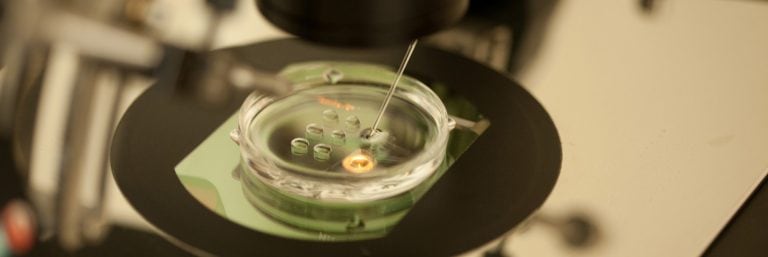
In the laboratory, using an elaborate microscope, one sperm is injected into each egg cell. The embryos are then „incubated“ (cultured) overnight in the incubator.
First, an egg cell is fixed on a glass pipette…
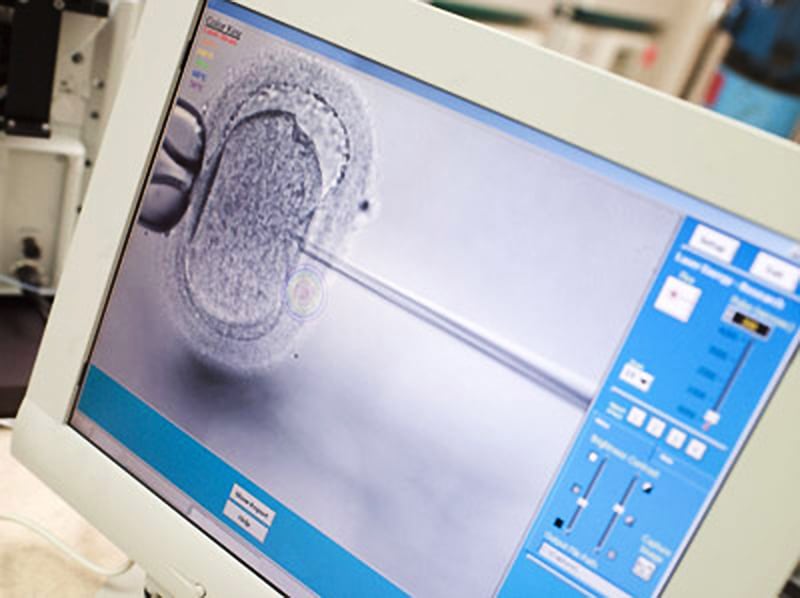
… then the sperm is injected directly into the egg cell with a glass capillary.
After 19-21 hours have passed, it is determined how many eggs have reached the so-called pre-nucleus stage (PN Stadium-Pro Nucleus). It is then necessary to select which PN-stage cells (max. 3) are to complete the fertilization process (at least in Germany). The pre-nuclei each contain the chromosomes of the egg cell and the sperm cell.
On the 2nd or 3rd day after sperm donation, when one or more embryos have developed, the embryo or embryos are transferred into the uterus. Transfer on the 5th day is also possible and advisable if one or more blastocysts have formed.
Further information about Blastocyst transfer
4th embryo transfer
On the 2nd, 3rd or 5th day after the sperm donation, the embryo transfer is performed. In this procedure, a catheter is inserted into the uterus, completely painlessly, if necessary under ultrasound control. The embryo(s) are then carefully deposited there. To prepare for this transfer, the woman may be given medications that relax the uterine muscles. By adding progesterone (a hormone produced by the ovaries: Crinone gel, Utrogest) optimal mucus conditions are to be achieved over the next 14 days for the implantation (implantation) of the embryo.
In the period after embryo transfer, excitement and excessive activity should be avoided, as should circulatory strain, e.g., through sports and high temperature increases, e.g., visits to saunas and hot tubs. Otherwise, no special recommendations are to be given. Sex is also more likely to be effective in a positive way.
Between 12 and 14 days after fertilization, a pregnancy test using urine or a blood test can be used to determine whether the woman is pregnant.
Here too, basic treatment can be individualized. The different types of treatment include: IVF, NC-IVF, Mini IVF and conventional IVF are described elsewhere.