Genetic testing of the embryo
In cooperation with the Human Genetics Laboratory Munich, it Kinderwunschteam Berlin has the approval to perform preimplantation diagnosis (PID), thus fulfilling all the professional requirements required by law to advise you individually and in detail about the current possibilities and limitations of PID and to offer you all the current procedures of PID within the strict legal framework.
If the longed-for pregnancy does not occur after many attempts at therapy, or if miscarriages keep occurring, it is likely that genetic causes are also suspected.
Preimplantation diagnosis (PID) The examination of an embryo – outside the mother’s body, before embryo transfer – for genetic disorders. PID is used to detect familial severe childhood diseases or earlier causes of death in children before the embryo is transferred into the uterus.
With the help of PID, serious genetic diseases that run in families can be detected before an embryo is implanted. In affected families, severe hereditary diseases have already occurred, disabled children have been born, or children have died very early, sometimes even in the womb. Preimplantation diagnosis (PID) can therefore be seen as a very early form of prenatal diagnosis.
However, if no genetic diseases are known in the family that lead to a serious childhood illness or the premature death of the child, PID may not be performed in Germany.
For the execution of a PID
1. Consulting and application of the PID
The first step is a genetic consultation and examination. This is carried out for our center by the Institute for Human Genetics in Munich by Dr. Nevinny.
Subsequently, the couple or patient seeking fertility treatment submits the application to the Bavarian Ethics Commission, which must review and approve the prerequisite for performing the PID in this case.
https://www.stmgp.bayern.de/service/pid/index.htm
To perform PID, artificial insemination (IVF / ICSI) is necessary. In this case, eggs (usually after hormonal stimulation) are extracted from the ovaries.
2. Hormonal stimulation of the ovaries & collection of the eggs
The fertilization process must be carried out by the intracytoplasmic sperm injection ICSI(). A single sperm cell is transferred into the interior of the egg cell. After fertilization occurs, the development of the embryo begins in the test tube.
3. Removal of the outer cell layer of the embryo
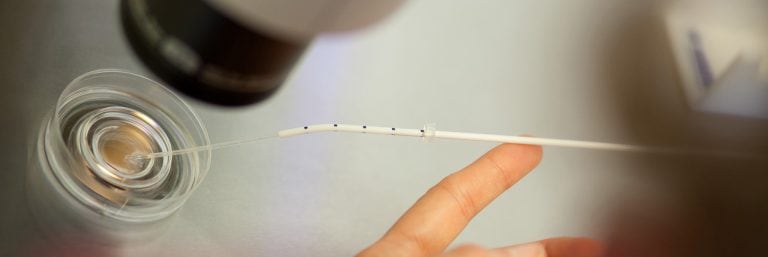
During PID, embryos are extracted from the „epithelial cells“ of the body (trophoblastic cells). They can no longer develop into a complete embryo on their own; instead, in the uterus, for example, they form the placenta. However, they contain the same genetic information as the embryo itself. Removing them does not damage the embryo. The removal of the trophoblastic cells (the so-called „trophoblast biopsy“) is performed during the PID technique on the embryo 5 days after fertilization: using a glass capillary, cells from the epithelial layer are extracted through the protective layer (zona pellucida). First, a tiny opening in the zona pellucida is created using laser technology. The cells are then subjected to molecular genetic or chromosomal analysis.
4. Cryopreservation during genetic analysis
Since this examination takes several days (usually 1-4 weeks), the embryos are frozen temporarily because the uterine lining is no longer capable of receiving the embryo due to this time shift.
The freezing technique is vitrification. As of today’s knowledge, there is no evidence of permanent damage to the embryo with this technique. However, approximately 5-8% of the thawed embryos do not survive the procedure.
5. Finding healthy embryos and transferring them into the uterus
The results of the genetic analyses are presented to the couple by the medical staff (through the human geneticists and reproductive medicine specialists) and weighed against each other. Only embryos without the severe genetic disorder or chromosomal abnormalities known to the parents are to be transferred into the uterus. This also takes into account the very rare possibility of misdiagnoses in the context of PID.
The transfer of the selected cryopreserved embryo can then be carried out in accordance with the usual rules.
6. Organizational notes regarding the prerequisites for the PID
Currently, health insurance companies do not cover the costs of PID treatment, or only in exceptional cases. This also applies to the costs of the necessary basic treatment for artificial insemination (ICSI), which is only covered if there is an indication from the restriction of sperm quality.
In any case, submitting an application is advisable and we support it.
7. Costs
The costs for the work of the ethics committee are 1500 euros and must be borne by the participants themselves. In addition, there are costs that ICSI arise in the context of one IVF or more projects. The total costs can in individual cases amount to up to 10,000 euros.
Please arrange an individual appointment for consultation regarding this complex therapy.