
Sperm diagnostics
General information about sperm diagnostics
Even a simple physical examination, consisting of observing secondary sex characteristics (e.g., body build and hair growth) and palpating the testicles, can give the examining physician initial hypotheses regarding the cause of infertility. However, the most important examination is certainly the sperm analysis (spermiogram) and, if necessary, the SFI (sperm fragmentation index) analysis.
Spermogram
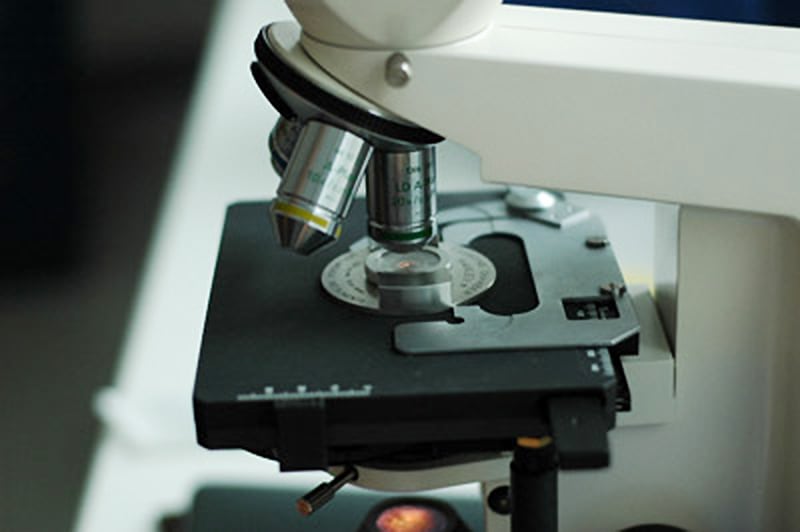
The examination of semen quality includes, among other things, the determination of sperm concentration, sperm motility and sperm morphology (% normal sperm shape).
HALO Test, SCSA Test
Further investigations, which determine the presence of molecular breaks in the genetic material in the sperm heads, provide additional information.
The spermogram
The basis of the diagnosis of possible male fertility problems is the spermogram.
Various parameters of the ejaculate (semen fluid) are examined here. However, the most important ones are:
- Quantity,
- pH value,
- Sperm concentration (in million sperms/ml),
- Morphology (proportion of normally shaped sperm cells in %)
- and the motility (mobility %).
Norm values according to the guidelines of the World Health Organization (WHO criteria):
Volume 2.0 ml or more
ph 7,2-8,0
Sperm concentration >=20 Mio/ml
Total sperm count >=40 million per ejaculate
Mobility (mobility) >=50 % with forward mobility
or >=25 % faster linear mobility
Morphology >=30 % with normal shape
Additionally, the following is assessed:
Leukocytes < 1 million/ml
MAR test < 10 % sperms with adherent particles
Evaporation time 30 minutes, max. 1 hour
Odour chestnut-like flowers
Further investigations if necessary:
Percentage of live sperm 75 % or more viable cells that do not absorb any dye in the eosin test
Note:
Morphology is often judged according to the so-called “Krueger strict criteria“ or “strict criteria”. According to these criteria, the proportion of malformed sperm can be as high as 85%, in order to still be able to judge the spermogram as normal.
Spermogram results can vary widely, so at least 2 (preferably 3) months should elapse between tests. The testes need about this time to produce new sperm. At least 3 and no more than 5 days of abstinence from sexual activity should be observed before the test.
Unfortunately, from the differentiated microscopic analysis of sperm quality, it is not always possible to obtain an accurate assessment of male fertility (fertility prognosis).
SCSA Test, HALO Test
Although the spermogram is the simplest test, it only provides partial information.
More and more studies in the international literature indicate that the proportion of sperm with chromosomal abnormalities within their genetic material can be of great importance for fertility on the one hand, as well as for risk of miscarriage, for example. However, this so-called fragmentation index (FI) cannot be detected by a normal spermogram (microscopic examination of sperm quality).
The HALO or SCSA test (Sperm Chromatin Structure Assay) offers the possibility to measure the fragmentation index. The additional knowledge of the sperm fragmentation index can be helpful in determining beforehand an appropriate fertility treatment. This makes it possible to avoid (possibly retrospectively considered as unlikely to be successful) months-long therapy from the outset. One reason for this is the occurrence of breaks in the genetic material in the sperm, so-called fragmentation.
With an increasing proportion of women, the chance of achieving a pregnancy naturally decreases.
Up to 25 % of the men with normal spermogram findings have a high proportion of sperm with fragmentation. In these cases, treatments such as transferring the sperm into the uterus (insemination) or using a laboratory-grown embryo can be used. (IVF/ICSI) It is advisable to have this test. Since the abnormalities in the hereditary material cannot be detected with the „normal“ spermogram, an additional examination is required, the so-called SCSA test or the HALO test. We perform the HALO test because it is less complicated and more cost-effective compared to the SCSA test.
The HALO test offers the opportunity to recommend individualized therapy in a timely manner, which in some cases can save time and money.
The cost of the HALO test is 160.00 euros. The examination is not yet reimbursed by either the statutory health insurance or the private health insurance.
The DNA fragmentation index (DFI) provides information about the success rate of the various treatment methods; in the evaluation, only the sperm are considered:
DFI 0-15 %:
A pregnancy appears to be possible in a normal way.
DFI 15-25 %:
A pregnancy through normal means is possible, but the duration until the onset may be prolonged. In cases where the pregnancy has already been ongoing for a long time: Infertility At least insemination therapy (sperm transfer) should be considered. In the presence of additional disorders in the woman and at older age, IVF (in vitro fertilization) is advisable.
DFI > 30 %:
Pregnancy by normal means or through insemination seems unlikely. The success rate can be improved through in-vitro fertilization IVF(IVF).
DFI > 50 %:
Pregnancy with IVF is unlikely; better chances are offered by the intra-cytoplasmic sperm injection ICSI().
DFI > 60 %:
Very low success rates; only chance with donor sperm ICSI or donor eggs.
The recommendations listed here are based on the findings of various working groups over the past few years and are merely recommendations in nature.