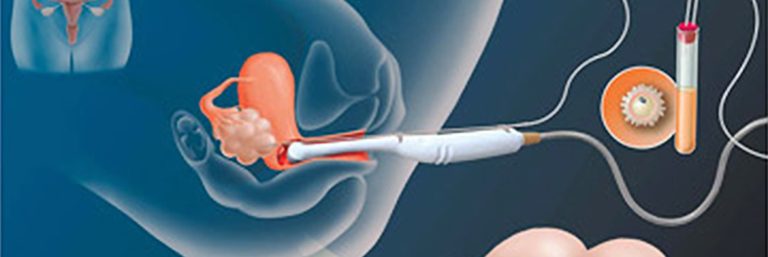
Oocyte retrieval methods
During the natural cycle, only one follicle (follicle) grows. To be able to produce several eggs at the same time, hormonal stimulation is required. By administering hormone preparations over several days, the growth of 10-15 follicles is usually achieved.
However, this stimulation is not completely risk-free for the woman. Considering that the treatment is not performed for a medical reason but to create a safety reserve of eggs, it is not acceptable to take risks. On the other hand, it is desirable to obtain a good number of eggs in as few treatment cycles as possible.
Our role as doctors is to coordinate the optimal treatment plan for you. We want to be able to obtain a sufficient number of mature eggs in as few treatment cycles as possible, so that your effort and costs remain acceptable.
Stimulation of egg cell growth
To achieve a good chance of pregnancy at the desired time of pregnancy, as a general rule it is recommended to freeze the number of eggs corresponding to the woman’s age at the time of freezing: 25 eggs in a 25-year-old woman, 30 eggs in a 30-year-old woman, etc. To protect the woman from an overstimulation cycle, one will not want to stimulate more than 15 follicles per cycle. This means that usually about 2-3 cycles are necessary to obtain the recommended number of eggs.
There are various stimulation protocols for IVF hypnotherapy. One of these protocols, which is known for its good controllability and its lower risk of overstimulation, is the so-called antagonist protocol.
Despite careful planning, it is not possible to predict with certainty how many eggs can actually be retrieved, nor how many of them are mature. Only cryopreservation of mature eggs allows for subsequent fertilization.
"Mini IVF"-stimulation – "IVF-natural"-as a special form of stimulation
In the so-called mini-IVF procedure, stimulation is carried out with a very small amount of hormones. In the IVF-Naturell procedure, if necessary, even without any hormonal stimulation. Concurrently, only a slight increase in the female hormone estrogen occurs. Especially after a hormone-sensitive cancer treatment, this protocol can be used.
The disadvantage of these protocols lies in the low „yield“ of eggs, as only 1-2 eggs often grow from them. This means that more cycles are needed. The medication costs are naturally much lower with these protocols, and overstimulation is practically excluded. Mini IVF or IVF-Naturell are not really suitable for social freezing.
Despite the use of the terms „mini IVF“ and IVF„conventional,“ it should be emphasized here explicitly that this involves the collection of only the egg cells, not a complete IVF process in which fertilization takes place. However, with „social freezing,“ unfertilized egg cells can also be cryopreserved along with fertilized egg cells.
Freezing fertilized or non-fertilized eggs?
When unfertilized eggs are preserved, the cells (individually or in groups, depending on the case) are thawed when pregnancy is expected and fertilized with the partner's sperm.
However, sometimes they also wish Couples delaying the onset of pregnancy into the future. Then the cells can be fertilized first. The advantage is that these fertilized cells are „more stable“ and survive the thawing at a higher rate.
If fertilized eggs – so-called pre-embryos (pro-nuclei) are preserved, they can only be used for pregnancy if both partners explicitly agree to treatment at that time. In the event of a separation, the woman cannot then use her egg reserve.
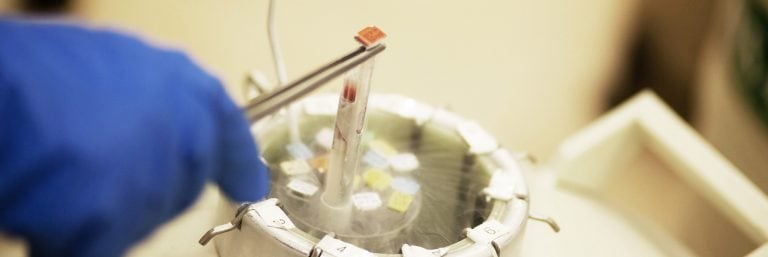
Freezing (cryoconservation by vitrification)
Unlike „slow freezing“ (SF), in which the cells are cooled to -196 degrees Celsius within about 30 minutes, in vitrification (V) the process is called „ultra rapid freezing“. In vitrification, a process lasting only a few seconds is used, during which a freezing agent is added and all water is removed from the cells. This prevents the potentially cell-damaging ice crystal formation. Months or years later, after thawing the cells, the potential cell-toxic freezing agent is removed first. This prevents damage to the cells. At the present time, there is no evidence of an increase in the rate of misformation in the child. Unlike „slow freezing,“ the so-called „survival rate,“ that is, the percentage of cells that survive the freezing and thawing process without harm, is significantly higher. With slow freezing, a survival rate of 60-65% is common %; with vitrification, 95 cells can even be repeatedly frozen and thawed.
Risks
The stimulation with clomiphene and low-dose so-called gonadotropins carries only minor risks; a certain „vampire-like feeling„ is to be expected; overstimulations rarely occur, but are only of short duration (a few days). Since the ovaries are more stimulated during “conventional IVF stimulation,„ the risk of overstimulation is somewhat higher here. In about 10-20%, a “vampire-like feeling” is to be expected, which will subside again after a few days. In 2-4% of the (especially under 30-year-old) women, however, a more severe overstimulation can occur. In this case, the ovaries may enlarge to up to 5-8 cm in diameter, which can lead to stronger abdominal pressure. The increased estrogen production caused by ovarian hyperstimulation can lead to the development of ascites (fluid in the abdominal cavity), which can cause a more or less severe impairment of physical well-being. In very rare cases, the fluid shift can lead to the thickening of the blood, which theoretically can also lead to thrombosis.
For the last few years, the final maturation of the eggs has been initiated using a so-called GnRH analogue. With this preparation, a syndrome of overstimulation is almost excluded. (See OHSS free clinic, (PDF)
Despite procedures following modern medical standards, it cannot be guaranteed that all expected eggs can be retrieved (premature ovulation, empty follicles). Nor can it be guaranteed that all expected/ retrieved eggs are mature and therefore suitable for freezing for preservation.
Costs for fertility preservation for personal reasons (so-called social freezing)
In accordance with the guidelines of the Social Code, measures for the cryopreservation of eggs are included. no as part of the coverage offered by statutory health insurance plans. In principle, the same applies to patients who are covered by a private health insurance plan. Therefore, it must also be assumed that the costs of subsequent artificial insemination will not be covered by the health insurance plan.
The resulting costs consist of the following points:
| Stimulation medications through a pharmacy | about 1000 € |
| Ultrasound laboratory services for egg retrieval | about 900 € |
| Freezing and storage for the first 6 months | 650 € plus VAT. |
| Each additional 6 months of storage | 150 € plus VAT. |