Anaesthesia
Anaesthetic procedures
General anesthesia puts you into a sleep-like state; that is, it shuts down your consciousness and, above all, your sense of pain.
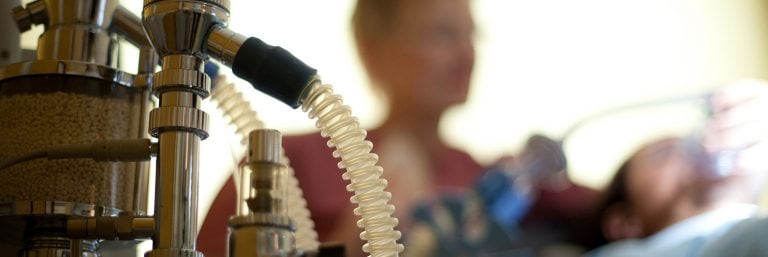
Most often, a sedative is injected into a vein (intravenous sedation). If the procedure takes longer, the sedative is administered repeatedly or additional gaseous sedative agents are administered in addition to oxygen. This can be done through a mask that covers the mouth and nose (mask) or over the larynx (laryngeal mask) (mask sedation).
During the anesthesia and afterwards, your blood pressure, pulse rate, heart rate, and oxygen supply are constantly monitored, so that any possible disorder can be detected and treated immediately.
It is quite normal to be tired and drowsy for a while after the anesthesia, and there is no cause for concern, even if this state should last for several hours (depending on the type of anesthesia). Each person reacts differently.
Procedure on the day of the operation
On the day of the operation, you should be in the clinic 30-60 minutes before the scheduled time of the operation. Please bring us the insurance chip card, the documents for the operation, and the consent form.
If you feel fear or intense excitement, ask us for a calming tablet with a sip of water.
After completing a few formalities, you will be taken to the preparation and recovery room, where you can change clothes. You can store your personal belongings there.
A plastic cannula is inserted into a vein on the back of the hand or at the elbow to allow medication and fluids to be administered. In the operating room, you will be seated in the operating chair and we will monitor your heart rate and breathing. A cuff on your upper arm automatically measures your blood pressure, a sensor on a finger monitors the circulation and oxygen supply in the blood, and to monitor heart activity, three ECG electrodes may be attached to your chest if necessary. During general anesthesia, your breathing and lung function are monitored after falling asleep via sensors on the ventilator.
After the procedure is completed, you can walk to your bed or your lying position yourself with our support. You will stay there for about an hour after the procedure.