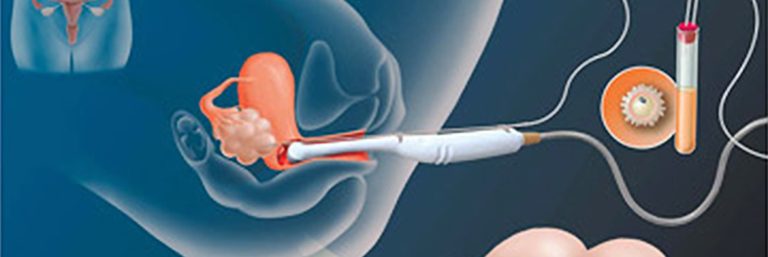
Maintaining fertility when wanting to have children later (so-called „social freezing“)
At the time of birth, the female baby has approximately 2 million eggs in the ovaries. This number drops drastically to about 400,000 by puberty.
During the fertile phase, a woman loses about 1000 eggs per month. At the same time as the remaining number of eggs decreases, their quality deteriorates. If a woman is 30 years old, every 2nd-3rd egg is basically of good quality; however, in a 40-year-old woman, this already drops to about every 5th-6th egg.
If the woman is in her early 40s, the chance of a natural pregnancy is approximately 10%. The birth of a child by a woman who has reached the age of 44 is a rarity.
Thanks to modern freezing techniques, known as vitrification, it is now possible to preserve eggs in order to postpone the desired pregnancy to a later stage of life. The prerequisite for this is that this „fertility reserve“ is achieved at a time when the quality of the eggs allows for an acceptable pregnancy rate.
The best time is therefore when a woman is in her early 30s. However, as experience shows, most women only begin to take the issue of „a child of their own“ seriously in their mid-30s.
With these pre-frozen eggs, a pregnancy rate can be achieved at a later date that corresponds to the pregnancy rate at the time of freezing, provided that sufficient eggs are frozen. As a rule of thumb: The reserve should contain as many eggs as the woman is old in years when frozen. That is 25 eggs in a 25-year-old woman, 30 eggs in a 30-year-old woman, etc.
It must be emphasized in a serious way: Pregnancy cannot be guaranteed with either „fresh“ or „cryopreserved“ eggs.
As we have repeatedly learned from the press, such a pregnancy is medically possible until the age of 70 – However, in the eyes of the vast majority of doctors, this is not desirable for the mother and the child for medical and psychological reasons. In Germany, there is a certain obligation on our part that we no longer want to initiate pregnancies after the age of 50.