Fallopian tube diagnostics
If the partner's spermogram is not affected or only slightly affected, it may be worthwhile to check the patency of the fallopian tubes.
To determine the continuity of the fallopian tubes, there are two essential examinations:
- the HSSG (Hystero-Salpingo-Soh nographie) Contrast agent examination (e.g. with Echovist ®)
- Chromalaparoscopy (dye flushing during abdominal ultrasound – laparoscopy)
- HSG
HSSG (Hystero-Salpingo-Sonoography), Echovist® examination
The advantage of the contrast agent examination is that it can be performed during an ongoing consultation without anesthesia. In the hands of an experienced examiner, this method is well tolerated and is more likely to be perceived as uncomfortable rather than as painful. A general anaesthetic is not necessary for this procedure.
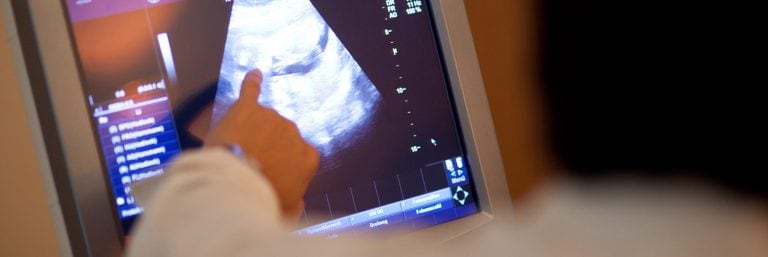
The examination takes place a few days before the expected ovulation (ovulation) in the gynecological examination chair. After disinfecting the cervix, a thin plastic catheter (tube) is inserted into the uterus. Through this, a sugar solution is injected, the flow of which (through the fallopian tubes) is often very well visible in the ultrasound image.
However, occasionally one can only „conclude“ that they are present continuously. This occurs when one cannot see the fallopian tubes themselves, but the contrast agent still flows into the free abdominal cavity.
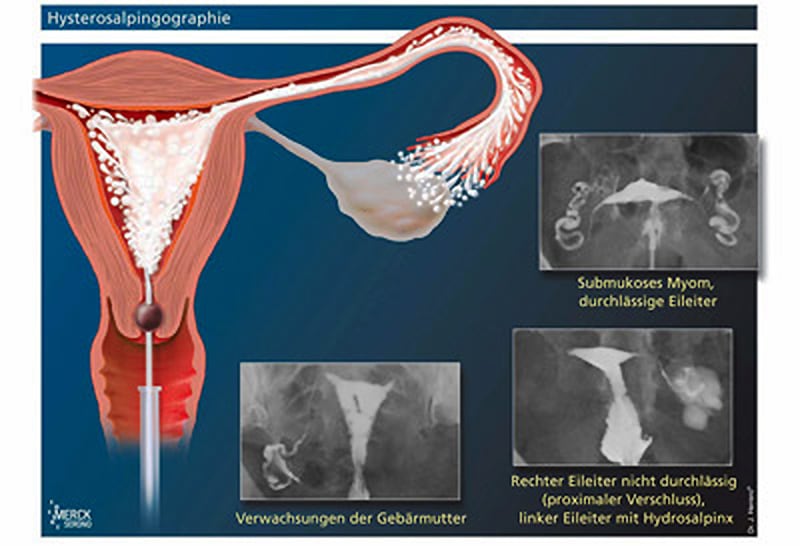
Additional information is obtained by injecting a saline solution before the contrast agent examination, which makes abnormalities in the area of the uterus visible (so-called hydrosonography). Depending on the experience of the examiner and the ultrasound technology, the accuracy of this examination is quite good.
„The predictive value of such an examination is over 90 percent in the positive case.“
(Keck, Neulen and Breckwoldt: Endocrinology, Reproductive Medicine, Andrology,
1999 Thieme Verlag).
Laparoscopy (abdominal examination)
The most comprehensive information about the condition of the internal genitalia (the internal sex organs) can be obtained through abdominal ultrasound (laparoscopy). This procedure can be used to perform contrast agent or dye flushing (chromopertubation) of the fallopian tubes, and also to obtain important information about the presence of adhesions (adhesions), inflammatory changes, and endometriosis. In a center equipped accordingly, the adhesions found can be resolved and endometriosis foci can be properly removed.
Laparoscopy should only be performed in this case, as it is an operative procedure, if the results of the examination indicate a consequence for the couple's further treatment. For example, if the spermogram is so restricted that IVF one is ICSI required anyway, such an operation is pointless and therefore contraindicated.
HSG (Hystero-Salpingography)
Before the development of Echovist®, which made it possible to visualize the fallopian tubes using ultrasound, HSG was a common diagnostic procedure. The procedure is similar to the described HSG, but X-rays and contrast agents are used here. For this reason, HSG with Echovist has quickly become widespread in at least Europe, as it can avoid the potentially harmful X-ray radiation that can damage the ovaries. HSG is still frequently used today in the USA, the Middle East, Latin America, and Africa.